Hahnweide is back! FW 190, Bf 109 and Me 262 at Europe’s Largest Vintage Airshow
It was a moment aviation fans had been waiting for over many years. For six long years, the Hahnweide lay quiet – at least when it came to the legendary Oldtimer Fliegertreffen. But on the second weekend of September 2025, it returned – with that unmistakable mix of nostalgia, excitement, and technical fascination that has made it Germany’s largest and most important vintage aviation gathering for decades.


Those who looked out over the fields and rolling hills near Kirchheim unter Teck early on Saturday morning saw the car parks already packed by nine o’clock, heard the distant rumble of approaching engines, and felt that something very special was about to happen.
Perfect Weather and a Perfect Comeback
Friday had already challenged both pilots and early visitors: strong crosswinds with a noticeable side component and a soft grass surface made landings on the short, slightly sloped runway demanding. But on Saturday, the Hahnweide showed itself from its best side – calm winds, clear visibility, and bright sunshine. Perfect conditions for what was to follow.

What made this 20th Oldtimer Fliegertreffen so special was that it didn’t feel like a restart, but rather a seamless continuation. “It’s as if it was yesterday,” many long-time visitors said. The atmosphere, the sound of the engines, the closeness to the aircraft – nothing had lost its charm.
Historic Gliders Opened the Sky


Early in the morning, as historic gliders filled the sky, many pilots and spectators stood at the fence with shining eyes. Thirteen vintage sailplanes – among them the Grunau Baby and DFS Habicht – opened the program, which would continue for another eight hours. Silently, they circled against the deep-blue sky, some passing directly in front of the moon still visible above. It was a tribute to the airfield’s gliding roots, a symbolic start showing that the Hahnweide honors its own history.
The Return of Legends: Bf 109E “Emil” takes the Stage
Then came the roar. In the late morning, the legendary Messerschmitt Bf 109E “Emil” appeared before the large crowd. A machine once thought lost, now fully restored and proudly presented in 2025 as the absolute star of the event. Its restoration had taken years, largely hidden from the public, and was now completed with full flight certification. What better place for its first public appearance than the Hahnweide?

Even the engine test run drew hundreds of cameras, and the deep growl of the Daimler-Benz DB 601 engine echoed like a historic sound cutting through the present. For many, this moment alone was the highlight of the weekend.
Parked among mostly American warbirds, the Emil looked surprisingly slender next to the muscular Mustangs and Corsairs. It was flown by Charlie Brown, the experienced British display pilot, performing at Hahnweide for the first time – and it became one of the most emotional flights of his long career.


“It’s my first time here in 35 years of display flying,” Brown said on Saturday afternoon. “The Hahnweide is a wonderful place. I treat this runway with great respect, but the location is just incredible. Last night, when the light hit Burg Teck and the aircraft came in to land, it was almost unreal. You can’t compare this to anywhere in England. Hahnweide stands on its own.”
Classic Trainers and German Icons
Shortly afterward, a Bücker Jungmann demonstrated how flight training worked in earlier times – slim, agile, and elegant. Several other Bückers were also present, proving how popular these light classics still are among German pilots.

Then came one highlight after another. A Focke-Wulf FW 190 replica from Braunschweig, piloted by Klaus Plasa, impressed with its power and grace. Soon after, the Messerschmitt Me 262 and Hispano Aviación HA 200, operated by the Messerschmitt Foundation and Airbus in Manching, flew in formation above the Hahnweide. Test pilots Geri Krähenbühl and Thomas Braun presented the early jets first together, then separately – a stunning demonstration of how far aviation technology had advanced by the 1940s. It was the Me 262’s only appearance in Germany this year – and its formation flight with the HA 200 a world-first.
On the Ground: Vintage Variety
Many other German classics could be admired on the ground: various Klemm aircraft, a Focke-Wulf Stieglitz, and the elegant Messerschmitt Bf 108 “Taifun” represented a proud civilian aviation tradition – travel, sport, and gliding machines from an era when flying was still an adventure.
Warbirds Captivate the Crowd
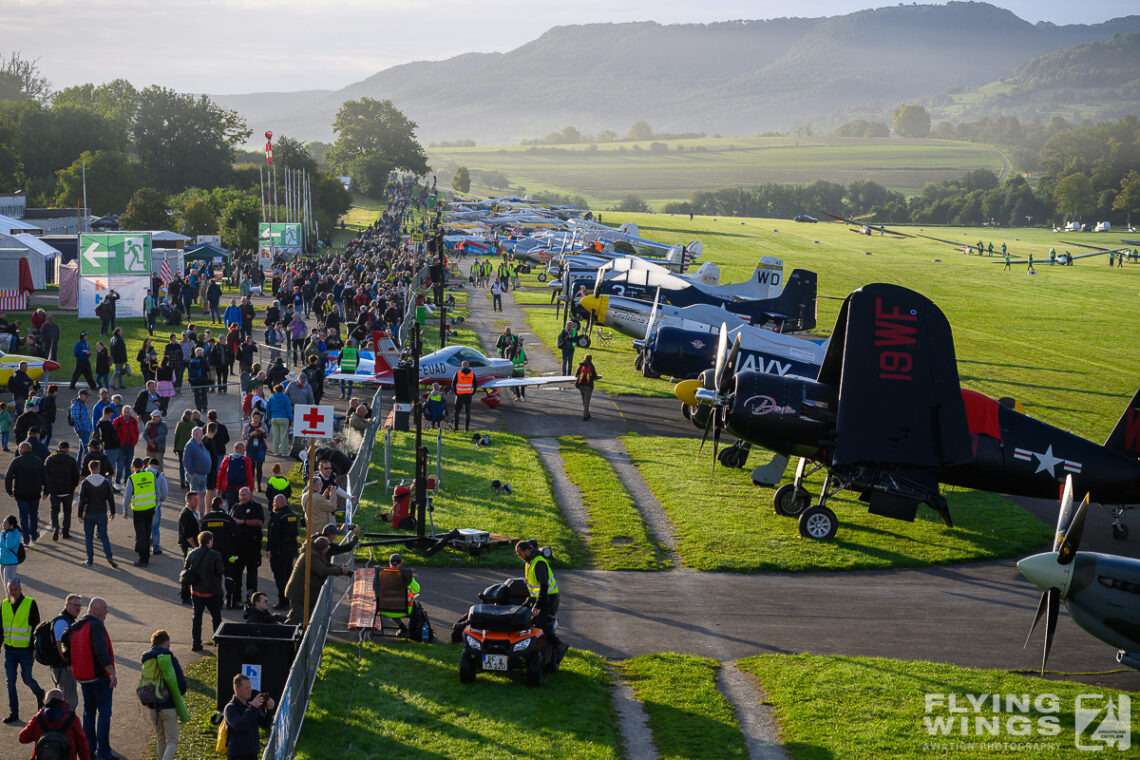
Of course, it was the big warbirds that drew the crowds – Mustangs, Spitfires, Corsairs, and the German legends Bf 109, Fw 190, and Me 262. Apart from the Flying Bulls from Salzburg, most of these powerful aircraft came from Germany itself, a clear sign of how far the national scene has developed. Germany no longer just consumes vintage aviation – it contributes to it on a world-class level.


The Flying Legends team from Siegerland Airport, led by Georg Raab with David Friedrich and Bernhard Diehl, brought along a Corsair, a Spitfire, and a Mustang. Raab, instrumental in building the fleet, spoke emotionally about Hahnweide’s importance: “It takes courage today to organize an event like this. But Hahnweide is the right place to showcase this kind of flying in Germany. There’s a special spirit here – you feel at home, among equals.”

He also explained the challenges: the Mustang needs almost the entire runway, and the Spitfire, he smiled, “is a lady in the air but a bitch on the ground.” Landings at Hahnweide, he said, are never routine – always a challenge, and that’s exactly what makes them so fascinating.
Emotion and Precision in the Air
The warbird displays were not only technically flawless but also masterfully choreographed. Solo flights alternated with formation displays; roaring warbirds followed elegant aerobatic and glider performances. The powerful T-28 Trojan followed the graceful Dewoitine D.26 and Morane-Saulnier MS317 – a dynamic and beautifully paced program.


Tribute to a Legend: The Missing Man Formation
The emotional high point of the weekend came with the Missing Man Formation for Walter Eichhorn, the legend of the German warbird and aerobatic scene who passed away earlier this year. Three T-6 Texans took to the skies, including his dark blue aircraft with the orange markings seen at countless airshows over the years. As his plane pulled up and away, the airfield fell silent. Many spectators had tears in their eyes – a reminder that this event is not only about machines and spectacle, but about people, memories, and living heritage.
Professional Organization and Safety
The organization of the event was impressively professional. From cooperation with authorities to traffic management and on-site safety, everything ran smoothly. Even the state aviation authority publicly praised the cooperation on Saturday morning. Emergency plans, permits, safety regulations – all handled with precision and care.
Closer to the Action Than Anywhere Else
Some changes were painful but necessary – such as the removal of the morning “flightline walk,” after visitors in previous years had ignored safety rules. Instead, the organizers positioned the most important aircraft right at the fence, giving everyone a great view while keeping the planes safe.


Displays took place directly in front of the audience – engine starts, taxiing, takeoffs, and landings on the grass runway. “Everything happens so close,” one visitor said. “You smell the oil, feel the vibration, see the pilots.” That’s what makes Hahnweide unique – not a sterile airshow, but a living celebration of aviation.
A Triumphant Return

After this unforgettable weekend, one thing is clear: Hahnweide has lost none of its magic. It’s back – and stronger than ever. The event proved that it belongs among Europe’s top aviation gatherings. While final visitor numbers were not yet available, tickets were sold out by Saturday, showing that expectations were far exceeded. Aircraft from Switzerland, France, England, Spain, and Scandinavia all contributed to making Hahnweide once again the grand finale of the European vintage flying season.
On Sunday evening, as most of the aircraft departed after a rainy day and the sun set over the Teck, many realized this was more than the end of an airshow. A tradition had been renewed, a community strengthened, and history brought back to life. Hahnweide lives – and those who were there will not soon forget September 2025.


Oldtimertreffen Hahnweide – OTT 2025 – Photo Gallery


You May Also Like
Shuttleworth – Fly Navy!
Slovak International Air Fest – SIAF 2018